Showing posts with label Aga Khani. Show all posts

Jan 17, 2018

Are Ismailis Muslims?

| |
0 comments


Are Ismailis Muslims Cover

Some say that anyone who testifies – says the kalimah ‘lā ilāha illā -llāh, muḥammadur rasūlu -llāh (There is none worthy of obedience and worship except Allāh and Muhammad is the final Messenger of Allāh), makes them a Muslim and we have no right to question that.
Sincerity, however, is subject to proof.
First of all, Islam is the religion prescribed by Allāh for the whole of mankind. That means, it is to be accessible to all. That is why there is no part of a masjid where secret rituals are performed and from which any Muslim is excluded. Even non-Muslims are able to attend and observe. Ismailis, on the other hand, have a closed-door policy. Even within themselves –  several separate gatherings (majalis) are held from which other Ismailis, who are disqualified and excluded from attending on the grounds that they have not paid the requisite fee for attending that particular majlis.
Outsiders may reserve judgment on the grounds that they do not know enough about Ismāʿīlism because of that ‘closed-door’ policy. Those constraints, however, cannot apply to those who have knowledge of Ismāʿīlism, as well as Islam.   Allāh chose the name of His deen as Islam; He defined it and called those who follow it – Muslims – in the Qurʾān.
The Prophet (sallallhu alahi wa salam) (peace be upon him) summarized it for us in two clear criteria. On one he said – Imaan(faith) is:
That you affirm your faith in Allāh, His angels, His books, His meeting, His messengers and that you believe in Destiny.
He also said that Islam is based on 5 principles (pillars):
  1. To testify that ‘none has the right to be worshipped except Allāh and that Muhammad is the slave and Messenger of Allāh’
  2. To perform prayers (Salat)
  3. To pay zakat (charity for the poor)
  4. To perform Hajj
  5. To observe saum (fast) in the month of Ramadhan
Does the Ismaili Kalima- where they add a third part “Amirul Momin Ali ul Allāh” (Ali, the Commander of the believers is of Allāh) take them outside Islam? By itself –  No! as other Shias do so, too.
However, their greeting – “Ya Ali Madad”  (‘O Ali help me’) and their supplications to “Ali” and “the Imam” – which they interchangeably use to supplicate to the Aga Khan, prove without a doubt, that they do not subscribe to that part of the Kalimah “that none has the right to be worshipped except Allāh.” Here they contradict themselves too, as they recite in their Holy Du’a, “You alone (Allāh) we worship and from you alone we seek help”!
In one of the Hymn (also called ‘ginans’) recited in the Jamatkhanas, they even sing to the Aga Khan:

“Haq toon, Paak Toon Baadshah” 

  حق توں پاک تون بادشاہ

Translation: “You are the Truth, you are the Holy, O Lord (King)”
These attributes of Truth and Holy ( Haqq and Quddus in Arabic) belong to Allāh and Him alone. However, Ismailis attribute these to Aga Khan.
The Aga Khan, has also the title “Mazhar of Allāh” meaning he is the “Shadow of Allāh” on earth. I leave it to you to decide that how can Allāh, who has no percieveable shape or form, have a light shining upon Him to form a shadow  on this Earth and what proof is there in Aga Khan’s claim that he is that shadow?
As far as salat is concerned, Ismailis try to put a smoke screen saying that their Dua’ is like  Namaaz – salat  by saying that we do sujud and they quote  Surat Al Fatiha, al-Ikhlas and few other verses from the Quran in their Holy Dua.
However, the format of salat has been with us from the Prophet’s (pbuh) times in which Muslims do qiyam, ruku, sujud, recite durud, face the qiblah and these are absent from the Ismaili 3 (instead of 5 daily Muslim) prayers . Incidentally, the way the Ismailis sit, it is not possible even to do a proper sujud.
Ismailis do not pay Zakat.  Instead, the Aga Khan claims Dasond – Tithe – 10 percent of one’s income regardless whether that income is sufficient or insufficient for one’s needs!
In case of Khoja Ismailis, he also claims an additional ‘two and half per cent’ contributions because he has given himself the role of a pir or dai. Then there are those Ismailis who belong to Mubarak Majalis (Gathering of the Blessed) they are required to give 25 percent of all their income, including personal allowance. So for example if the wife elects to join, and the husband who has given 12.5% on his income and gave $ 500 as personal allowance to his wife, she would pay $125 as Dasond and say on Eid or Birthdays children and husband gave Money and clothes ( purchased from monies left after already having paid their 12.5%) amounting to $200, she would be obliged to pay an additional $50!
The actual Islamic Zakat as prescribed by the Quran, is payable on “surplus wealth” i.e. excluding necessities such as home for residing in and a vehicle for transport held for 12 months at 2.5% only which means that poor people are exempted from paying and the monies collected are to be spent on those qualified e.g. poor, widows, etc. as specified in the Qurʾān.
By tradition, the Prophet and members of the household are specifically excluded from receiving any part of Zakat Funds. They were paid from Bayt-ul-Maal from voluntary donations towards building/running of Mosques and communal administration.  It is strange that Aga Khan claims to be from the household of the Prophet and still collects an inflated Zakat, called Dasond.
Hajj is neither compulsory, not encouraged in Ismailism. Instead, Ismailis believe that the glimpse of Aga Khan is equal to that of a Hajj. Every Ismaili should look at the Aga Khan (or perform a deedar) at least once in a lifetime.
Fasting is not obligatory and at times eating (sukhreet) and drinking of holy water – Niyaz which are part of the rituals on Fridays and certain Majalis (congregations  additional to daily religious rituals are performed)  take place during the time of fasting!
So we see from the forgoing that if a litmus test (which the Qurʾān and Hadith) provide is applied, Ismailism fails on several core areas.
There is one further point I would like to make. Allāh completed and perfected the deen of Islam and gave no one the authority to change it.
Interestingly, the late Aga Khan in his memoirs, states:
“What has been my own policy with the followers? Our religion is our religion; you either believe in it or you do not. You can leave a faith but you cannot, if you do not accept its tenets, remain with it and claim to ‘reform it’. You can abandon those tenets, but you cannot try to change them and still protest that you belong to the particular sect that holds them.”
Yet he can change the doctrine, rites and rituals of Islam and still claim to be a Muslim! This is a strange logic and sense of integrity which would befuddle any ordinary mortal! 
To be truthful, logic and rationality are sorely lacking in Ismaili rituals. For example they recite the Salwat: “Allahumma Salli ala Muhammad in wa ale ala Muhammad”  during Jamati supplication (Giriyazari Tasbih). So they beseech Allāh to bestow His peace upon Prophet Muhammad and his progeny (descendents) (followers) but then conclude by saying, “Ya Ali Ya Nur Mowlana Shah Karim Al Husseini tun salwatji tasbih toje hazur pur mein kabool kar” – ( O Ali, O Light of our Lord Shah Karim Al Husseini accept our supplication)!
In my opinion, by the criteria of the Ismaili Imam himself, they disqualify themselves from belonging to the Muslim Ummah.
Read More

Nov 1, 2015

The Truth About Ismaili Ginans: Inspiration from Quran or from Vedas?

| |
1 comments


Introduction

Ginans (devotional songs in Indian languages) are the basis and foundation of Ismailism. Disputing the pre
aching of a Ginan by a Ismaili would be similar in significance to the contradiction of the teachings of the Quran by a believing Muslim. Any study of the Ismaili Tariqah, without the study of the origins of Ginans and their influence upon Ismailis, would be an incomplete study.

Who Wrote The Ginans?

Aga Khani Ismaili women reciting Ginans
which they believe are interpretation
of the Holy Quran.
Forefathers of the present day Khoja Ismailis were converted by Pirs (پیر) from Hinduism with the Ginanic preaching.
“Pir” is a Persian word. It means Murshid, Guru, an authorized teacher. For a Ismaili, the teachings of a Pir are to be obeyed, word for word.
Al-Waez Abualy A. Aziz has quoted a Farman of an Imam on Page 134 of ‘Ismaili Tariqah’ to show that the obedience to Pir is obligatory upon every Ismaili. The quoted Farman reads:
“The Pir is the person to whom the Imam of the time has granted his position which makes him the highest amongst his creation (ashraf-imakhluqat) and whenever the Imam has chosen the Pir and appointed him, he must convey to others the knowledge in detail. You must attain perfection in the knowledge of the Imam through him. Therefore it is obligatory upon you to follow the Pir, never flinching from his obedience. Be bound by what the Pir tells you, acting as he says and when you obey the Pir, the Pir in the Hereafter will pray to God for your protection”.
Ismailis recite Ginans everyday with love and devotion in their Jamatkhanas, but most Ismailis have not studied the History and origin of these Ginans. They believe that each and every Ginan that is recited in their Jamatkhanas and/or published by the Ismailia Association is composed by an authorized Pir and must be obeyed. However that is not so. In fact, there are more Ginans composed by non-Pirs than there are by Pirs.

Appointed Pirs and Their Children

Al-Waez Abualy A. Aziz writes on pages 134 and 135 of his book ’Ismaili Tariqah”:
“The children of our Holy Pirs were also respectfully called Pirs. They were not the Appointed Pirs as Hujjatul Imam but they were dais, missionaries. They were Sayyids. There is nothing wrong to call these children of our Holy Pirs as Pirs. Our Pirs and their children composed the Ginans in various Indian languages. The present collection of our Ginanic literature is the work of our tenAppointed Pirs and more than twenty of their children. Bhagat Kara Ruda said that more than forty Sayyids among the children of our Holy Pirs, particularly the children of Pir Sadruddin and Pir Hasan Kabirdin, had composed thousands of Ginans, most of which were lost with time”.

Ginans Authored by Anonymous Authors

Aga Khani Ismaili publication promoting
the 'relevance' between Quran and Ginan
Professor W. Ivanow, a well known Russian scholar and a reputed researcher of Ismaili history has translated many books and manuscripts of Ismaili literature. He writes in his book ‘Ismaili Literature’ (Tehran University Press – 1963) on Page 174:
“A great majority of Ginans are the creation of anonymous authors. Apparently quite a considerable proportion of those attributed to the authorship of Great Pirs probably have nothing to do with them, and were composed at a much later date. This particularly applies to the gnans about various Pirs, their miracles, their sayings”.
Hundreds of Ginans which were composed by the children and grandchildren of the pirs were attributed to Pir Sadruddin and Pir Hasan Kabirdin by these descendants. Writing new Ginans and selling them to newly converted Khojas was the main source of income for these hundreds of relatives of Pirs. Ismailia Association for India has confirmed these facts and added that “out of 18 sons of Pir Hasan Kabirdin, 17 sons had opened various religious Bazaars of their own and had started their own independent factories. Some of these so called Sayyids had even established their own sects.
In 1969, the Ismailia Association for India published a series of Collection of Ginans (2nd Edition). This series includes Ginans composed by officially appointed authorized Pirs, Ginans by Sayyids (descendants of the Pirs) whose names and brief history are published in the introduction, and also Ginans composed by so-called Sayyids, whose historical record is neither available, nor known.
Below are three excerpts from the introductions of this series published from Bombay, India by the Ismailia Association:
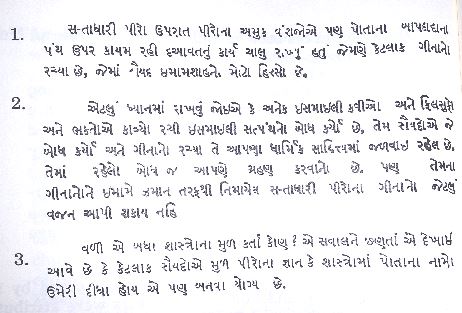
Introduction to "Series of Ginans, 2nd Ed." published by Ismailia Association for India in 1969.
Introduction to “Series of Ginans, 2nd Ed.” published by Ismailia Association for India in 1969.
Translation:
1. Besides the authorized Pirs, descendants of the Pirs have also propagated faith in the same manner as their fathers and grandfathers. These descendants have composed some Ginans in which Sayyid Imamshah’s contribution is the greatest.
2. It should be borne in mind (by Ismailis) that many Ismaili Poets, Philosophers and Bhagats (devotes) have written songs and propagated the true path of Ismailism. Similarly Sayyids (and one Sayyidah) have also composed Ginans and propagated the faith. These compositions have been preserved in our religious literature. We have only to adopt the preaching that are within these compositions (Ginans). But, the Ginans of these composers cannot be given the same “weight” as those composed by the authorized Pirs that were nominated by Imam-e-Zaman.
3. Who were the original creators (composers) of all these sacred writings (Ginans)? In trying to find an answer to this question it is being observed that it is likely that some Sayyids (descendants of Pirs) might have added their names to the original Ginans or sacred writings created by Pirs.
It is evident from the last excerpt that the Ismailia Association is trying to impress upon Ismailis that although a Ginan may mention the name of a Sayyid or Sayyidah as the composer it could be a composition of an authorized Pir. In other words, it should be given the same “weight” as an authorized composition. The collection of “Ginans” published by the Ismailia Association for India is made from the following categories:
1. Authorized Ginans composed by appointed Pirs
2. Devotional Songs composed by known Sayyids
3. Devotional Songs composed by unknown Sayyids
Officially, Ginans and Songs are both called Ginans. Both are being equally honoured, trusted and obeyed by Ismailis, because they bear the same nomenclature. In some cases the name of a father appears as the creator Pir and his son’s name appears, in the same verse, as the reciter Pir. There are even cases where the prefix ‘Pir’ is added to the name of the composer when he is neither a Pir nor a descendant of any Pir or Sayyid. Below is one such “Phony Ginan” created during my lifetime.

About The Phony Ginan “Par karo beda Guruji”

A Ginan which begins with “Par karo beda Guruji” is often being recited in the  Jamatkhanas of Canada. It is a “song” composed by Head Master (Head Teacher) Hussain Gulamhussain Hussaini of a religious night school at Khadak, Bombay, India in the 1940’s. In those days I was one of the teachers in that school. The Head Master had a poetic talent and used to compose songs for students of the night school to sing in the night school “Majlis”. Later on, this particular song became a “Ginan”. Master Hussaini who had composed the song, under the pen-name of “Musst” (in high spirits – carefree),
became ‘Pir Musst Musst Hussaini” instead of ‘Musst Master Hussaini”. The majority of Ismailis do not know such historical facts behind the origin of Ismaili Ginans. A missionary would not reveal these facts, in order to preserve the “weight” of Ginanic literature. They want Ismailis to obey each and every “Ginan” with the same respect in spite of the fact that there are more unauthorized Ginans than there are authorized ones.

Who wrote “Garbis” of Pir Shams?

Ismaili sources record that Pir Shams was sent to India by one of their Imams from Iran. He was born in Iran. He died in Multan, Pakistan (formerly India). The custodian of the shrine in Multan has a genealogy tree (Sajrah) which records that he was born in Gazhni and came from Afghanistan. He was not an Ismaili and he did not propagate the Ismaili faith. However, the point to note is that he was a foreigner when he came to India. History records that he traveled from Afghanistan to Sind, Punjab, Kashmir and Tibet and settled in Multan (Punjab) where he died. Even the Ismaili sources have no records of his stay in Cutchh, Kathiawar or Gujrat where the inhabitants speak Gujrati.
In the Jamatkhanas of Punjab, Ismailis recite Ginans in Punjabi which they say were composed by Pir Shams, seven centuries ago. In most of the other Jamatkhanas the world over, Ismailis recite Garbis (folk songs in Gujrati to which men and women would dance at a festival, with music), Kathas, Salokas and Ginans in Gujrati which they claim were all composed by Pir Shams. This entire collection in Gujrati language would be of over 2000 verses.
This gives rise to a series of questions:
1. When and where did Pir Shams learn Gujrati?
2. Why would he compose and sing Ginans in Gujrati before his non-Gujrati adherents?
3. Was the art of poetry writing in Gujrati already developed 700 years ago?
Examining the standard of the language of the Garbis and Ginans by Pir Shams, one can say that they are the work of an individual well versed in contemporary as well as medieval Gujrati.

Who edited “Pir Pandiyat-i Jawan-mardi”?

It is interesting to note that in the Ismaili Tariqah, one of the “Authorized Pirs” is a “Book”. The Book is supposed to have been written by a Nizari Imam whose name was called Mustansir Billah II. The Book is called ‘Pir Pandiyat-i Jawan-mardi” – a strange name for a Pir. For more details please read page 123 and 124 of ‘A Brief History of Ismailism’ by Abualy A. Aziz.
Professor W Ivanow translated “Pir Pandiyat-i Jawan-mardi’ into English and published the text of the work and its translation through ‘The Ismaili Society’, Bombay, in 1953. Ten years later he wrote:
“Taking into consideration the fundamental differences between various versions of the text, mentioned in the Introduction, it is easy to suspect that the work (Pandiyat-i Jawan-mardi) has passed through the hands of Khayrkhwah (Herati) who had no scruples about ‘editing’ it, and probably ultimately it reached India in his version”.
‘Ismaili Literature’ Tehran University Press, 1963. Page 139

Who wrote “Kalam-i Pir”?

Khayrkhwah Herati is also suspected by Professor Ivanow of committing ‘the worst plagiarism” and converting “Haft-bab-i Bu Ishaq” (Haft-bab written by Abu Ishaq Quhistani) into “Haft-bab-i Shah Sayyid Nasir” (Haft-bab written by Sayyid Nasir-i Khusraw), otherwise known as “Kalam-i Pir“. This book is considered as “Pir”, by Ismailis of Badakshan and Northern Pakistan. It has also been translated by Professor W. Ivanow into English in 1959.
“Editing” of books written by Pirs and Imams is not an uncommon practice in this Unique Tariqah. The “edited” version is treated with the same veneration and glory as if it was the original unedited version, because an Ismaili cannot distinguish the edited portion from the unedited.

Who made “w’Allah” (“By God!”), into Allah?

Over a period of seven centuries, the original Ginans have gone through lots of transitions. Most of the old Ginans have either been lost or removed from circulation permanently In their places new Ginans have been added. Ginans were composed by Sayyids (male and female) until the last century.
Many Ginans have been edited by the Ismailia Associations.
Some Ginans are banned by the Imams.
Others have been modified or recast to incorporate Shia beliefs or to glorify the image of Ali. For example, the word “Hari” has been replaced with “Ali”, “Swami” is changed to “Sami’ and “w’Allah e’hi Imam” meaning “By God! that (Islam Shah) is Imam” has been altered to read “Allah e’hi Imam” meaning “Allah that is (equal to) Imam”, (nauzbillah).
The texts of some of these Ginans are beyond human reasoning and logic. Yet, in spite of these corruptions, Ginans are the basis of Ismaili beliefs. Ismailis burst with joy and pride when they sing “Allah e’hi Imam” not knowing that they are uttering a blasphemy and committing a heinous sin.
On pages 136 and 137 of ‘Ismaili Tariqah’ Abualyhas quoted nearly a dozen or so Farmans of Aga Khan III on Ginans. Reproduced below are three Farmans:
“Pir Sadruddin composed the Ginans, in Indian languages, which are the extracts from the Quran” – Aga Khan III
“Pir Sadruddin has given you, in his Ginans, the tafseer (interpretation) of the Quran-e-Shariff”. – Aga Khan III
“Pir Sadruddin has guided you to the Right Path. If (instead) you will follow the path of the Moguls and the Arabs, you will be lost”.  – Aga Khan III

Prophet Muhammad came to India as “Pir”

On page 133, Abualy has quoted a Ginan of Pir Sadruddin in Gujrati and has given the translation thereof as under:
Translation: 
“Before the creation there was Nabi Mohammed Mustafa. The same Murshid has come to India.”
Such fantastic claims made in the names of Pirs are the basis of the Ismaili Tariqah’s bizarre teachings and beliefs of the repeated incarnations of Hazrat Ali (ra) and Prophet Muhammad (pbuh) as the ‘Avtaras‘ of Hindu deities; ‘Vishnu’ and ‘Bramah’ respectively, from before the Creation. Ismailis are also taught that the Pirs who came to India were the holders of the Noor of Prophet Muhammad (pbuh) – the Bramah, and the Aga Khans are the final Avtaras of Lord Vishnu. Rama and Krishna were also Avtaras of Vishnu.

Prophet acknowledged Ali was the Creator

Quoted below is another “Unique Ginan”. The Ginan is published under a collection entitled “Momin Chetavni“. This Ginan is in connection with the birth of Ali ibn Abu Talib. It narrates a dialogue between Muhammed Mustafa (who was not yet Prophet and was 29 years of age) and a group of Angels who had come down from heaven to see Ali ibn Abu Talib, who had just been born.
Translation: 
‘When Nabi Muhammed, the leader of the Angels, returned after doing his  Salaam (to Ali), the Angels said to Nabi Muhammed
“He (Baby Ali) is the creator of ‘Arsh Kursh’ (Heavenly throne);
He (Ali) is the one who has commanded us and kept us under your leadership.
He is indeed the same, without any doubt.
Then Nabi Muhammed replied:
“Brother Angels, let me tell you my thoughts; He (Baby Ali) has made known to me, he is the Creator of this Universe”.
Can these Ginans be considered as the “extracts from the Quran”? Does the Quran speak of “Ali the Creator of this Universe”?
No Muslim in his right mind would believe a single verse of the above Ginans. Any individual (Muslim or non-Muslim) who has read the history of the Great Prophet of Islam would say that when the Prophet Muhammad heard Angel Jibrael (Gabriel) for the first time in his life, it was in the cave of Mount Hira and he being about 40 years old. If the Prophet at the age of 29 years knew “Ali is the Creator of this Universe” then why did he go to Mount Hira? Why was the Prophet shocked to hear the voice of Angel Jibrael in the cave, if they both had known each other and spoken before? Finally, who told the Pir what the Prophet said to the Angels 700 years ago? Such Ginans are the basis for establishing the “Unique Supremacy” of Ali and his successors, the Aga Khans.
Allah created Adam and gave him wisdom. He implanted in him the faculty of knowledge and judgment, before sending him upon this earth. He also gave him the power of reasoning, intuition and instinctive feelings. He therefore enjoys a special place within the creation of Allah – “Ashraful Makhlukat“. Allah has honoured Adam to be His vicegerent on earth – “Khaliful Ardh“. We, the human race, inherited these faculties. Today, the sources of acquiring knowledge are unlimited and easily accessible. This makes one wonder why Ismailis of this 20th century who are so advanced and discerning in managing their financial affairs, become so gullible as to place their entire confidence in Ginans, and base their religious beliefs on such bizarre Ginanic legends of Ali and Nabi and not upon the Quranic teachings?
The Quran teaches: “Say I (Muhammad) am no more than a human being like you”. Holy Quran 18/10
As for the supremacy of Hazrat Ali; in the Fatimid period (i.e. pre-Alamut and preGinanic period), Ali was considered as “al-Wasiyin wa Wazir Khair al-Mursalin”, meaning “the distinguished Nominee and Representative(Wazir) of the Messenger”. These words were inscribed on the obverse of the Fatimid Dinars to describe their Imams – the descendants of Ali.
Should not the Aga Khan ask his followers to consider him, ‘Wazir of the Messenger’, since he claims to be a descendant of the Fatimid Imams?

Who are Moguls and Arabs?

Incidentally, there is another Farman of Aga Khan III which speaks of Moguls as being  “beggars” and Arabs “like donkeys’ and “what will they teach Ismailis?” The Farman is in “Khojki” (a script especially developed by Khoja-Ismailis, for private records and secret writings). This Farman was made on August 20, 1899 in Zanzibar, Africa.
(Here appears in the book, the original text of the Farman in Khojki).
Translation: 
“Pir Sadardin has shown you the straight path, if you leave that, and walk upon the talks of Moguls and Arabs, then you will fall down. Arabs are like donkeys. What will they teach you? They themselves do not know anything, then what will they teach you? Moguls seek alms in every country. What will they teach you? If you follow their talks, then you too will become donkeys”. (Bahere Rehmat, pages 30 & 31)
Aga Khan III tells Ismailis in the Farman that if they follow the words of Moguls and  Arabs they will fall down and become like donkeys. The question is, who was Aga Khan III? Did he not call himself a Hashemite? Who were Hazrat Ali (r.a.) and Nabi Muhammad (s.a.s.)? Finally, who is Aga Khan IV? Is he Italian, French, British, Irani or an Arab? He calls himself Karim al-Hussaini. Who were Hashem and Hussain, if not Arabs?
Muslims – those who submit to Allah – have based their religious beliefs by reference to the “Words of their Creator” – the Quran. Ismaili Momins – those who submit to their Imams – have based their religious beliefs by reference to the “words of Poets” – the Ginans. Which Tariqah is on the right path? Allah says:
“Shall I inform you, (O people!), on whom it is that the evil ones descend? They descend on every lying, wicked person, (into whose ears) they pour hearsay vanities, and most of them are liars. And the Poets, — it is those straying in evil, who follow them: Seest thou not that they wander distracted in every valley?  And that they say what they practise not?” Holy Quran 26/221 to 226
Read More

May 1, 2015

Majālis, Mandlis and the Rejection of Zakāt in Ismā‘īlīsm

| |
0 comments


Like other pillars of Islam, zakat is rejected in Ismailism. Instead, the followers of Aga Khan are required to pay something called dasond (دسوند). Unlike in Islam, where zakat is paid yearly on savings at the rate of 2.5% per annumdasond is paid to Aga Khan monthly on earnings at the rate of 12.5% – 25% per monthdepending upon the level of membership a Ismaili holds in the Jamat.

1. What is Dasond?

The word dasond is a derivation from das-ans or das-ant, which means “tenth part”. A contribution of 10% means dasond. To this, a share of 2.5% is added for the current pir (پیر). In Ismailism, the shah (شاہ), which means the current Imām, is responsible for collecting the 10% dasondwhile the current pir is responsible for collecting 2.5% of his share. The present Aga Khan claims to be both the shah, as well as the pir. Hence he collects both of these which comes to 12.5%.
Aga Khan III sent the following reply to a letter by Dr. Pir Mohammad Hoodbhoy, declaring that he held both the offices of the Shah and the pir.
16th October, 1954

My Dear Hoodbhoy,

In reply to your letter of 8th October, the colors of our family are, as you know, red and green, the reason being that we represent both the (offices of) shah and the peer.

The Shah was Hussein, the pir was Hasan. Hasan had the pir’s color of green, but Hussein’s martyrdom was so enormous in events and was so opposed to even the smallest laws of war that the color of his holy blood, namely red, was accepted with the green of the Prophet’s flag as a souvenir and remembrance of that terrible day.
Ismailis consider the Imām to be their spiritual father and pir to be their spiritual mother, even though both of them have historically always been male. As mentioned above in his official letter, Aga Khan III claimed both the positions of spiritual motherhood as well as spiritual fatherhood.

2. Dasond to be Paid Directly into Jamatkhana and Not as Charity to the Poor

It is general knowledge among Muslims that the eight permissible recepients of zakat are clearly spelled out in the Quran in Surah at-Taubah (The Repentance), Chapter 9, Verse 60 as follows:

إِنَّمَا الصَّدَقَاتُ لِلْفُقَرَاءِ وَالْمَسَاكِينِ وَالْعَامِلِينَ عَلَيْهَا وَالْمُؤَلَّفَةِ قُلُوبُهُمْ وَفِي الرِّقَابِ وَالْغَارِمِينَ وَفِي سَبِيلِ اللَّهِ وَابْنِ السَّبِيلِ ۖ فَرِيضَةً مِّنَ اللَّهِ ۗ وَاللَّهُ عَلِيمٌ حَكِيمٌ

Translation:
Zakah expenditures are only for the poor and for the needy and for those employed to collect [zakah] and for bringing hearts together [for Islam] and for freeing captives [or slaves] and for those in debt and for the cause of Allah and for the [stranded] traveler – an obligation [imposed] by Allah . And Allah is Knowing and Wise.
Now let us see how vast is the difference is in Ismailism:
This summer, I had the pleasure of meeting an influential Ismaili social worker that  had just returned from his tour of India and Pakistan. He had one very important and valid question on his mind. Since I have lived in Pakistan, he imagined that I would be in a better position to answer his query or else elucidate on the subject. His question was in connection with the Aga Khan Hospital in Karachi, Pakistan.
One of the senior administrators of the Age Khan Hospital, who keeps on visiting continent after continent, collecting millions of dollars for the hospital project had informed the Jamat that in Pakistan, that the “Muslims” (a term used by Ismailis for non-Ismailis) are contributing theirzakat to the hospital.
The question of the visitor was that if that was the case, then could he adjust his past donations to the Aga Khan Hospital against his future contributions of dasond? Alternatively, can he funnel his dasond money to the Aga Khan Hospital, in the future, or to any other lsmaili “Boarding School” (term used for Orphanages)?
He also mentioned that back home it was not difficult to collect cash under the table. In Canada, paying of the dasond in cash to mukhi (minister of the Aga Khan) without obtaining a receipt poses accounting problems. The amount contributed cannot be deducted as expenses on his income tax returns. Physical cash has to be withdrawn from a bank and handed over personally to the ministers of the Aga Khan in the Jamatkhanas every month. At times, there are long queues at the banks and also in the Jamatkhanas to submit the dasond money. Finally, there is a question of savings. Contributions paid to a registered institution having a tax exemption means a big saving in the income tax.
My response was that the senior administrator he had named was not only a roving ambassador but also a very highly paid kingpin at the Aga Khan Hospital. I had no reason to doubt the statement made by him in public or before the Jamat. If “Muslims” can regard their donations to the Hospital as Zakat, then Ismailis can offset their donations to the Hospital as dasond.
In principle, a Ismaili should be able to pay 2.5% to Aga Khan as the share of pirand the balance of 10% can be offset against his contributions as poor-dues to charitable hospitals and orphanages if he so chooses. However, this is not permissible in Ismailism and all dasond has to be paid directly into the Jamatkhana by every Ismaili.

3.  Dasond Rates and Mandli Memberships

Every Ismaili is supposed to pay 12.5% of his gross income as dasond. There are thousands of Ismailis in Canada who pay 25% of their gross income to Aga Khan. They pay this higher contribution because they are members of an exclusive mandli(group) called ‘Mubarak Mandli‘ or ‘One-fourth Mandli‘. They hold secret monthly meetings called “One-fourth Majlis” in Jamatkhanas throughout the world. They pay their dasond of 25% in their Majlis to the mukhis of their Mandlis and not to themukhi of the Jamatkhana.
An Ismaili who is not a member of the ‘Mubarak Mandli’ cannot participate in their Majlis. Aga Khan gives members of the Mubarak mandli private audiences and makes special farmans. He also gives them special blessings. My wife was a member of a Mubarak Mandli. She paid 25% of her personal income, or pocket money received from me and also on the gifts and prizes received by her. My wife would not tell me the farmansmade for ‘Mubarak Mandli‘. She had a book of ‘Private and Confidential Farmans’ for her group which I was not allowed to touch. I believe they consider Aga Khan as their “Partner” or vice verse. I am told there is a group above the Mubarak. The members of these groups, I am told, pay 33.3% of their income to Aga Khan. I have not met any member of this Mandli because they would not reveal their identity, nor would anyone confirm their existence.
On the other hand, I was a member of ‘Noorani Mandli’, of which my wife was not a member. I was not allowed to tell my wife what transpired in our Majlises nor what was revealed by Aga Khan to our private group of elite. To become a member of “Noorani” I had to pay a considerable sum, to the treasurer of Aga Khan, as an entrance fee. I was not issued a receipt for the amount tendered nor a membership card or a certificate. When I attended the first Majlis of my Noorani Mandli, I was surprised to see that practically every well-to-do Ismaili was in the group. Non-members – usually those who could not afford the entrance fees – were not allowed to participate in our Majlises. After the Majlis they were invited to help as volunteers, to serve our lunches and dinners. Every Ismaili is virtually segregated from another Ismaili, or a husband segregated from his wife and vice verse, based on memberships of these mandlis.
Before joining the ‘Noorani‘ I passed through half a dozen smaller segregated Groups or Mandlis; each having their own designated place in the community. After my joining the Noorani Mandli, I was told of a few other Mandlis that were above my group. I have no idea where this hierarchy of elite and super elite Ismailis come to an end. All I know is that the higher the Mandli, the higher the entrance fee and the more segregated you become. Aga Khan gives separate audiences to each Mandliand makes appropriate farmans. The more you pay the closer you are considered to be to Aga Khan. His farmans give you that sense of elevation. The names designated to these Mandlis also identify the class distinctions. Surprisingly, the only requisite for it is, how much you can afford to pay in “cash”. There are Mandlis which are equivalent to clubs of the recipients of “Purple Heart” or “Victoria Cross“. The Membership criteria is money. In other words money is the root of all elevations and distinctions.

4. Triple Taxation

From my personal experience I can say that an Ismaili bread-earner would pay 12.5% of his income to Aga Khan. He then would give his wife pocket money to buy her clothing and other needs. Then his wife would pay 25% of the pocket money, as her Mubarak Mandli dues to Aga Khan. Then, she would give her children a weekly allowance. Each child would pay 12.5% to Aga Khan out of his or her allowance.
I have often asked missionaries, “Why should the wife pay 25%, if the husband has already paid 12.5% prior to the payment of pocket money?” Since I was not a member of the Mubarak, it was not an appropriate subject for me to discuss, and missionaries are not allowed to discuss matters pertaining to “Mubarak” with non-members. A childhood friend of mine is a member of “Mubarak” and so is his wife. In their family, the rate of “triple Dasond” is 25% – 25% – 12.5%. That gives me some consolation that in my family the rate was 12.5 – 25% and 12.5%.
During the period of his Imamat, Aga Khan III had made very strict Farmansfor Dasond. Some of his Farmans suggested that losses may occur by fire and sickness if Dasond was not paid in full, and also mentioned that without the Dasondthere was no foundation for the religion. An Ismaili cannot attain “Noorani Deedar” (spiritual glimpse of Aga Khan) or make any progress in his esoteric meditation if he defaults in his payment ofDasond. On the other hand, contributors of Dasonds will be repaid here, and hereafter in the ratio of 1:125,000.
The present Aga Khan has not made any specific Farmans for Dasonds, but by the same token has not stopped collecting Dasond or has not stopped giving his “special blessings” to members of the Mubarak Mandli.

5. Dasond is Also Due to be Paid by Recipients of Charity

On the evening of February 8th 1970, Karim Aga Khan was sitting on a sofa in the Prayer Hall (Jamatkhana) of Muhammadi Girls’ Academy Karachi, with his shoes on. I was standing beside him with my shoes off and nearly 200 resident boarders of the Academy and staff members were sitting on the floor facing the Aga Khan. They all were reciting ‘Salwat’ with their hands clasped and raised.
After the usual ceremonies of Niaz, Memanis, Blessings and Farmans, Karim Aga Khan was about to get up from his sofa when the innocent young girls of the Academy, who were dressed in white, began crying. Tears started rolling down their tiny cheeks. The girls were seeking forgiveness, but for what? Aga Khan was surprised. He asked me what was the problem. I asked Mukhiyani the reason. She began talking to Aga Khan in her usual manner and language, which Aga Khan could not understand. She was speaking about ‘Dasond‘ and was pointing at her wrist. With a look of bewilderment, Karim Aga Khan – the one “who has the knowledge and authority of every thing” – asked me to explain what the Mukhiyani had related.
Before I continue further, I wish to inform you that the Ismailia Youth Services – a parent body of Muhammadi Girls’ Academy and Prince Aly Boys’ Academy had hired an Ismaili lady-missionary to teach Ismailism to the girls of the Academy. She was a member of special Mandli mentioned before. She had probably indoctrinated the girls about ‘Dasond’ to be paid from the charitable donations collected. I clarified before Karim Aga Khan that the girls of the Academy who were crying, had certain concepts about Dasond. Because the 12.5% Dasond was not being paid from donations collected, they felt that the food prepared from the money was not pure. Pointing to the veins on her hand the Mukhiyani tried to describe the fact that the blood produced from the food also was impure. Consequently the girls could not progress in their Bandgi‘ (meditation) every morning.
Thereupon, Aga Khan made a Farman to the girls which stated that any money received by him as Dasond is returned. If they paid the Dasond it will be paid back. This was not a simple Farman, to pay or not to pay the Dasond.
In the following meeting of the Ismailia Youth Services I was bombarded with questions. I was requested to strain my memory and repeat theFarman verbatim precisely, because it could be misinterpreted. Unfortunately, no other member of the Youth Services or of the Academy was present at that moment. I could not be precise as I did not make notes. During their two hours tour of boys’ and girls’ Academies, I must admit I answered dozens of questions and heard that many remarks, advises and jokes from their Highnesses.
The issue was delicate and concerned the fundamental aspects of Ismaili religion. The members could not come to a unanimous decision as to the paying of theDasond , out of charity money. It was resolved that a guidance be sought from Aga Khan by writing a letter.
Aga Khan replied that the Ismaili Youth Services should pay a token amount, every month, in the Jamatkhana as a dasond. Now came the real problem, how to pay theDasond in cash without any written acknowledgment of the payment? The treasurer would not release funds every month without a voucher because the auditors would not pass such withdrawals. The second question was about justifying to the donors the payment of dasond. Some of them were giving donations in lieu of thedasond  and they would not like their contributions channeled to the treasury of Aga Khan.
Finally, a member of the Youth Services agreed to pay the sum demanded by Aga Khan in the Jamatkhana every month, for a period of one year out of her pocket. Before the year was over I was nominated as President of the Council and had to relinquish my post with the Ismailia Youth Service and Muhammadi Girls’ Academy. I am not sure, but I believe that the farman of the Aga Khan to pay dasond, from the charitable donations, is still being diligently followed. The money continues to go from the pocket of the Youth Services or its members into the collection bag of the mukhi.
Today, the girls of the Academy who were crying must be grown and perhaps, they may be wondering was it necessary to pay “poor dues” (dasond) out of charity money? Was non-payment a reason for not gaining progress in their ‘bandgi‘? “Do we have to follow the teachings of our teachers, missionaries or parents, if they are teaching us or asking us to practice a belief that is sinful in the eyes of Allah?”
Allah mentions in Surah al-Ankabut (The Spider), Chapter 29, Verse 8:

وَوَصَّيْنَا الْإِنسَانَ بِوَالِدَيْهِ حُسْنًا ۖ وَإِن جَاهَدَاكَ لِتُشْرِكَ بِي مَا لَيْسَ لَكَ بِهِ عِلْمٌ فَلَا تُطِعْهُمَا ۚ إِلَيَّ مَرْجِعُكُمْ فَأُنَبِّئُكُم بِمَا كُنتُمْ تَعْمَلُونَ

Translation:
And We have enjoined upon man goodness to parents. But if they endeavor to make you associate with Me that of which you have no knowledge, do not obey them. To Me is your return, and I will inform you about what you used to do.
The above is an improvised extract from Akberally Meherally’s Understanding Ismailism: A Unique Tariqa of IslamDownload the complete book from here for free.
Read More
Akbar Khoja. Powered by Blogger.