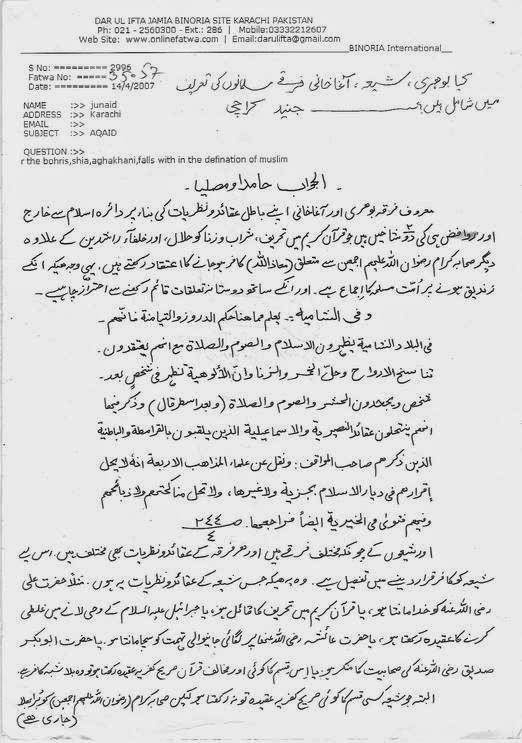
Aga Khani Ismaili missionaries drill into the mind of average Ismaili
from childhood that “Ulil Amr” is Aga Khan himself, including his
predecessors and successors. The basis of this claim is Chapter 4:Verse
59 of the Qur’an:
يَا أَيُّهَا
الَّذِينَ آمَنُوا أَطِيعُوا اللهَ وَأَطِيعُوا الرَّسُولَ وَأُولِي
الْأَمْرِ مِنكُمْ فَإِن تَنَازَعْتُمْ فِي شَيْءٍ فَرُدُّوهُ إِلَى
اللَّهِ وَالرَّسُولِ إِن كُنتُمْ تُؤْمِنُونَ بِاللَّهِ وَالْيَوْمِ
الْآخِرِ ذَٰلِكَ خَيْرٌ وَأَحْسَنُ تَأْوِيلًا
Transliteration:
Yā ‘Ayyuhā Al-Ladhīna ‘Āmanū ‘Aţī`ū
Allāha Wa ‘Aţī`ū Ar-Rasūla Wa ‘Ūlī Al-‘Amri Minkum Fa’in Tanāza`tum Fī
Shay’in Faruddūhu ‘Ilá Allāhi Wa Ar-Rasūli ‘In Kuntum Tu’uminūna Billāhi
Wa Al-Yawmi Al-‘Ākhiri Dhālika Khayrun Wa ‘Aĥsanu Ta’wīlāan
Translation:
O you who believe! obey Allah and obey the
Messenger and those in authority from among you; then if you quarrel
about anything, refer it to Allah and the Messenger, if you believe in
Allah and the last day; this is better and very good in the end.
Aga Khanis usually quote the initial part of the verse to
support their false belief due to the fear that their false
interpretations will be exposed from the remaining part of the verse
itself. They just quote:
Transliteration:
Yā ‘Ayyuhā Al-Ladhīna ‘Āmanū ‘Aţī`ū Allāha Wa ‘Aţī`ū Ar-Rasūla Wa ‘Ūlī Al-‘Amri Minkum
Translation:
“O you who believe! Obey Allah and obey the
Messenger and those in authority (Ulil Amr) from among you (min kum).”
(Qur’an 4:59).
…they deliberately leave the remaining portion of the same verse, which is:
Transliteration:
Fa’in Tanāza`tum Fī Shay’in Faruddūhu
‘Ilá Allāhi Wa Ar-Rasūli ‘In Kuntum Tu’uminūna Billāhi Wa Al-Yawmi
Al-‘Ākhiri Dhālika Khayrun Wa ‘Aĥsanu Ta’wīlāan
Translation:
“…then if you quarrel
about anything, refer it to Allah and the Messenger, if you believe in
Allah and the last day; this is better and very good in the end”.
As we can clearly see in the second part of the verse which Aga
Khanis avoid quoting, that Allah (swt) commands believers, that when
there arises a dispute between believers and Ulil Amir, at that time
they need to
refer back to Allah and the Messenger. We shall analyze verse 4:59 in the sections which follow.
1. Unconditional Obedience is only for Allah and his Prophet
2. Proof from Quran that Obedience to Ulil Amr is Conditional
3. Proof from Hadith that Obidience to Ulil Amr is Conditional
4. Proof from Circumstances of Revelation for Verse of Ulil Amr
5. Conditions for Disobeying Ulil Amr According to Hadith
6. Imam Ali’s (ra) Understanding of Ulil Amr as in Nahjul Balagah
7. Proof from Quran that Ulil Amr Has Nothing to do with Imamat
8. Conclusion
1. Unconditional Obedience is only for Allah and his Prophet
This verse 59 of Surah An-Nisaa is precisely teaching the criteria
for evaluating deen of a person. i.e., he or she should believe that:
“Other than the Prophet himself, there is absolutely no other human who
is perfect enough to be right all the time and whose words or actions
could be followed on his own authority, without strong support from the
Quran and Sunnah. Several verses of glorious Quran over and over clarify
that absolute obedience is for Allah and his Prophet(pbuh) only:
Say, “Obey Allah and the Messenger.” But if they turn away – then indeed, Allah does not like the disbelievers. (3:32)
And obey Allah and the Messenger that you may obtain mercy. (3:132)
All who obey Allah and the messenger are
in the company of those on whom is the Grace of Allah,- of the prophets
(who teach), the sincere (lovers of Truth), the witnesses (who
testify), and the Righteous (who do good): Ah! what a beautiful
fellowship.(4:69)
And obey Allah and obey the Messenger and
beware. And if you turn away – then know that upon Our Messenger is
only [the responsibility for] clear notification. (5:92)
So fear Allah and amend that which is between you and obey Allah and His Messenger, if you should be believers. (8:1)
O you who have believed, obey Allah and His Messenger and do not turn from him while you hear [his order]. (8:20)
And obey Allah and His Messenger, and do not dispute and [thus] lose courage and [then] your strength would depart; and be patient. (8:46)
Allah says: “…Obey Allah and His Messenger…” (33:33)
One who disobeys God and His Messenger is in plain error.(33:36)
O you who have believed, obey Allah and obey the Messenger and do not invalidate your deeds. (47:33)
As it can be noticed from the above verses of Quran, that the
absolute obedience is always for Allah and his Messenger(pbuh) only.
However, the verse 4:59 adds a new element, it tells us to obey Allah
and obey the messenger and those in authority (Ulil Amr).
2. Proof from Quran that Obidience to Ulil Amr is Conditional
Observe that the word “obey” (أَطِيعُوا) is placed in front of the
words Allah and Messenger (pbuh) BUT NOT in front of the word “Those in
authority (Ulil Amr)”. Allah did not say “wa atiu Ulil Amri minkoom”
(and obey those charged with authority),
rather Allah kept it
merely at “and those in authority over you” (without adding the word
“OBEY” before it) as a sign to indicate a conditional obedience. This
is because their obedience is tied with the obedience of Allah and his
messenger, if the ones in authority (Ulil Amr) obey Allah and Prophet
(pbuh),
then and only then do we obey them.
Since this verse is an exception, it is also accompanied by a
condition, and the condition is that if we differ with the ones in
Authority(Ulil Amr) we should return the matter to Allah and his
Messenger (pbuh), WHY? Because only they are divine and infallible and
their obedience is absolute. We CAN differ with the ones in authority
(Ulil Amr) but we
CANNOT differ with Allah and his Messenger (pbuh).
Let us look at the verse 59 of Surah An-Nisaa carefully and
reflect on its contents. The verse commands believers to obey Allah
(أَطِيعُوا اللهَ), who must be obeyed in His own right because He is the
Creator, Owner, and Master. Then the verse repeats the command and
says, “Obey the Messenger” (أَطِيعُوا الرَّسُولَ), who should also be
obeyed in his own right as the Messenger of Allah, because Allah sent
him and ordered us to obey him. He also told us in 4:80: “Whoever obeys
Messenger, he in fact obeys Allah.”
In both of these segments
the command “obey” (أَطِيعُوا) was repeated,
because obedience to both was on their own authority and in their own
right: One as the Creator and the second as His Messenger. Then the
verse continues: “and those charged with authority” (وَأُولِي الْأَمْرِ
مِنكُمْ). For this segment
the command ‘Obey’ has not been repeated,
indicating that the obedience to Ulil Amr (those charged with
authority), although necessary for the existence of an organized
community, is subservient to the obedience to Allah and His
Messenger. The obedience to Ulil Amr must only be in matters and orders
that are in line with and supported by clear injunctions from Allah and
His Messenger.
The Ulil Amr cannot demand obedience in their own
right or on their own authority, but only in compliance of the
teachings of the Quran and Sunnah with clear support from them. That
is why the word ‘obey’ (أَطِيعُوا) has not been repeated for them. Had
obedience to Ulil Amr not to be constrained within the provisions of the
Quran and Sunnah, the style would have been different: Either It would
have only one ‘obey’, i.e., “Obey, Allah, the Messenger and Ulil Amr” ;
or, obey for all three parties, “obey Allah, obey the Messenger and obey
Ulil Amr”. However, the contruct used was different than both of these
formats.
The constraint upon the obedience to Ulil Amr is further clarified and emphasized by the next segment of the verse,
“If you differ in anything among yourselves, refer it to Allah and His Messenger”. That
is: if there is a difference of opinion between rulers (Ulil Amr) and
ruled (common people) or any segment of the Ummah, then the matter must
be referred only to Allah and His Messenger (Quran and Sunnah). In other
words, it must be decided and settled according to the Quran and Sunnah
that are the basis of religion. There is no mention of Ulil Amr this
time because their opinion or order is not on the basis of their own
authority but rather it is acceptable only when it is clearly supported
by the provisions of the Quran and Sunnah.
3. Proof from Hadith that Obedience to Ulil Amr is Conditional
3.1 Narrated `Imam Ali that the Prophet sent for a skirmish (
sariya)
under the command of a man from the Ansar and ordered the soldiers to
obey him. He (i.e. the commander) became angry and said “Didn’t the
Prophet order you to obey me!” They replied, “Yes.” He said, “Collect
firewood for me.” So they collected it. He said, “Make a fire.” When
they made it, he said, “Enter it (i.e. the fire).” So they intended to
do that and started holding each other and saying, “We run towards (i.e.
take refuge with) the Prophet from the fire.” They kept on saying that
till the fire was extinguished and the anger of the commander abated.
When that news reached the Prophet he said, “If they had entered it
(i.e. the fire), they would not have come out of it till the Day of
Resurrection.
Obedience (to somebody) is required when he enjoins what is good.”(Sahih al-Bukhari 5.629)
Comment: From this
narration we found that obedience to the one in authority was necessary
but when there rose a dispute, the result was given in the favor of the
ones who sided with the teachings of Prophet (pbuh), it was not said
that the one in authority should have been obeyed, because what the one
in authority commanded was against Allah and his Messenger (pbuh).
3.2 Sayyiduna Abd Allah (Allah be pleased with him)
narrates that the Messenger (pbuh) of Allah said: A Muslim must listen
to and obey (the order of his ruler) in things that he likes or
dislikes, as long as he is not ordered to commit a sin. If he is ordered
to disobey Allah,
then there is no listening and no obedience. (Sahih al-Bukhari 6725 & Sahih Muslim 1839)
Comment: We find that
obedience to ruler is compulsory in general case, as the first part of
the verse(4:59) says us, but if the ruler orders to disobey Allah then
there is no obedience to him. Thus proving that obedience to rulers is
conditional.
4. Proof from Circumstances of Revelation for the Verse of Ulil Amr
Let us look at the ‘Sabab Al-Nuzool’ (“occasion/circumstances of
revelation”) of the Ayah to further strengthen the fact that (4:59) was
not revealed for the obedience of some future Ulil Amr Imams but those
Ulil Amr who were appointed by the Prophet (pbuh).
4.1 Narrated Ibn `Abbas: The verse “Obey Allah and
Obey the Apostle and those of you (Muslims) who are in authority.”
(4:59) was revealed in connection with `Abdullah bin Hudhafa bin Qais
bin `Adi’ when the Prophet appointed him as the commander of a Sariyya
(army detachment).This was narrated by Bukhari from Sadaqah ibn al-Fadl
and also by Muslim from Zuhayr ibn Harb and both transmitter related it
from Hajjaj. (Sahih al-Bukhari 6.108)
4.2 Said Ibn ‘Abbas, according to the narration of
Badhan: “The Messenger (pbuh) of Allah (swt) sent Khalid ibn al-Walid in
a military expedition to one of the Arab clans. He was accompanied in
this expedition by ‘Ammar ibn Yasir. When he drew closer to them at
night, he stopped to camp in order to try to conquer them the following
morning. Meanwhile this clan was warned about the approaching military
expedition which made them flee the area, except for one man who was a
Muslim. This man asked his family to get ready to move and then he went
to the camp of Khalid and entered in on ‘Ammar. He said to him: ‘O
Abu’l-Yaqzan! I am one of you. But my people ran away when they heard
you were coming. I stayed because I am Muslim. Is this of any benefit to
me, or shall I flee as my people did?’ ‘Ammar said: ‘Stay, for it is
beneficial to you’.The man returned to his family and told them to stay.
The following morning, Khalid invaded the clan but found no one except
this man, and so he imprisoned him and seized his property.‘Ammar went
to him and said: ‘Let the man go, for he is a Muslim and I have already
given him amnesty and told him to stay’. Khalid said: ‘You give
protection from me to others while I am the leader!’ Ammar said: ‘Yes, I
give protection from you to others while you are the leader’. And they
exchanged angry words.Then they both went to the Prophet, Allah bless
him and give him peace, and informed him about the man. The Prophet,
Allah bless him and give him peace, gave the man amnesty, sanctioned the
amnesty that ‘Ammar had given to the man and then forbade him from
giving amnesty to anyone in the future without the express permission of
his leader. ‘Ammar and Khalid insulted each other in the presence of
Allah’s Messenger, Allah bless him and give him peace, and when ‘Ammar
spoke very rudely to Khalid, the latter became very angry and said: ‘O
Messenger of Allah, will you allow this slave to insult me? By Allah, if
it were not for you, he would not insult me’. ‘Ammar, by the way, was a
client of Hashim ibn al-Mughirah. The Messenger of Allah, Allah bless
him and give him peace, said: ‘O Khalid, leave ‘Ammar alone, for whoever
insults ‘Ammar, Allah will insult him, and whoever hates ‘Ammar, Allah
will hate him’. Upon which ‘Ammar left. Khalid followed him, and held
him by his cloak and asked him to forgive him, which he did.
Allah, exalted is He, then revealed this verse, enjoining obedience to those who are in authority”. (Asbaab Al-Nuzool’ for 4:59 by Abu Al-Hassan Ali Ibn Ahmad Ibn Muhammad Ibn Ali Al-Wahidi)
5. Conditions for Disobeying Ulil Amr According to Hadith
5.1 It has been narrated on the authority of ‘Auf b.
Malik that the Messenger of Allah (may peace be upon him) said: The
best of your rulers are those whom you love and who love you, who invoke
God’s blessings upon you and you invoke His blessings upon them. And
the worst of your rulers are those whom you hate and who hate you and
whom you curse and who curse you. It was asked (by those present):
Shouldn’t we overthrow them with the help of the sword? He said: No, as
long as they establish prayer among you.
If you then find
anything detestable in them. You should hate their administration, but
do not withdraw yourselves from their obedience. (Sahih Muslim Book 20, Number 4573)
5.2 It has been narrated (through a different chain
of transmitters) on the authority of Umm Salama (wife of the Holy
Prophet) that he said: Amirs will be appointed over you, and you will
find them doing
good as well as bad deeds. One who
hates their bad deeds is absolved from blame. One who disapproves of
their bad deeds is (also) safe (so far as Divine wrath is concerned).
But one who approves of their bad deeds and imitates them (is doomed).
People asked: Messenger of Allah, shouldn’t we fight against them? He
replied: No, as long as they say their prayer. (” Hating and
disapproving” refers to liking and disliking from the heart.)
Comment: From the above
narrations we find that Prophet (pbuh) himself declared that there would
be Ameers (rulers) who would be doing bad as well as good deeds, yet
Prophet (pbuh) commanded that they need to be obeyed. (Sahih Muslim Book
20, Number 4570)
5.3 Narrated Ma’qil: Allah’s Apostle said, “
If any ruler having the authority to rule Muslim subjects dies while he is deceiving them, Allah will forbid Paradise for him.” (Sahih al-Bukhari Volume 9, Book 89, Number 265)
Comment: This
hadith also proves that Ulil Amr could be ones who can be deceivers and
therefore might command something which is not in line with Quranic
commandments and Prophetic traditions.
5.4 Al-Nauman ibn Basheer told us: The Prophet
(pbuh) said: ‘Prophethood will remain in you for as long as God decides
for it to remain and then God will remove it when He decides to remove
it. After Prophet hood, there will be a Caliphate on the style of
prophethood and it will exist for as long as God decides for it to
exist, then He will remove it when He decides to remove it.
Then
there will be a kingdom in which people will face trials and
tribulations and it will continue to exist for as long as God decides
for it to exist. Then He will remove it, when He decides to remove it.
After this, there will be an oppressive kingdom and it will continue to
exist for as long as God decides for it to exist. Then He will remove
it, when He decides to remove it. Then there will once again be
a rule on the style of prophethood. After saying this, the Prophet
(pbuh) was silent.’ (Takhreej Mishat al Masabih #5306)
Comment: This shows that
there would be a time when the ones in rule will be Tyrants and
Oppressors. Aga Khan too, has been referred to as having an ‘earthly
kingdom’ (Vanity Fair, February 2013)
6. Imam Ali’s (ra) Understanding of Ulil Amr as in Nahjul Balagah
Let us see Ali’s (ra) understanding and interpretation in his
book “Nahjul Balagha (Peak of Eloquence)”. In the Letter #53 to
al-Ashtar al-Nakha’ee whom He (ra) had appointed as the ruler of Egypt,
he writes:
“Maalik, You
must never forget that if you are a ruler over them than the caliph is
the ruler over you and Allah is the Supreme Lord over the caliph. And
the reality is that He has appointed you as the governor and tested you
through the responsibility of this rulership over them.”
And then He says:
وَارْدُدْ
إِلَى الله وَرَسُولِهِ مَا يُضْلِعُكَ مِنَ الْخُطُوبِ (1)، وَيَشْتَبِهُ
عَلَيْكَ مِنَ الاْمُورِ، فَقَدْ قَالَ اللهُ سبحانه لِقَوْم أَحَبَّ
إِرْشَادَهُمْ: (يَا أَيُّهَا الَّذِينَ آمَنُوا أَطِيعُوا اللهَ
وَأَطِيعُوا الرَّسُولَ وَأُولِي الاْمْرِ مِنْكُمْ فَإنْ تَنَازَعْتُمْ
فِي شَيْء فَرُدُّوهُ إِلَى اللهِ وَالرَّسُولِ)، فَالرَّدُّ إِلَى اللهِ:
الاْخْذُ بِمُحْكَمِ كِتَابِهِ (2)، وَالرَّدُّ إِلَى الرَّسُولِ: الاْخْذُ
بِسُنَّتِهِ الْجَامِعةِ غَيْرِ الْمُفَرِّقَةِ
“When
you are faced with problems which you cannot solve or with a difficult
situation from which you cannot escape or when uncertain and doubtful
circumstances confuse and perplex you, then turn to Allah and the Holy
Prophet (s) because Allah has thus ordered those whom He wants to
guide: “Obey Allah and obey the
Messenger and those in authority among you. And if you disagree over
anything, refer it to Allah and the Messenger” The way to turn to
Allah is to act diligently according to the clear and explicit orders
given in His Holy Book and to the turn to the Holy Prophet (s) means to
follow those of his Sunnah about which there is no doubt and ambiguity
and which have been generally accepted to be correctly recorded.”
(Nahjul Balagha, Letter #53)
Therefore, Ali (ra) advised to Maalik, who was appointed in authority
over Egypt, that if he faced any problem or difficulty then he needed
to turn to Allah (swt) and Prophet (pbuh), because Allah mentioned in
Quran the verse 4:59, and its later part commands to refer Allah and his
Prophet during disagreement.
It is obvious from this letter of Ali (ra) that that Ali (ra)
considered Maalik who was appointed in authority over Egypt as Ulil Amr
(the one who is in authority) which is why He (ra) directed Maalik to
the verse 4:59 which is about, what is to be done when their appears a
dispute between Ulil Amr and Believers. Ali could have said if you face
any problem refer to me, but He (ra) didn’t say anything as such. It is
surprising that even Ali (ra) who is considered by Aga Khani Ismailis as
Aga Khan’s predecessor never considered himself as Ulil Amr, but Aga
Khan himself does consider himself one and has even gone to the extent
of modifying or abolishing all pillars of faith.
7. Proof from Quran that Ulil Amr Has Nothing to do With Imamat
One final proof for those who would like to debate on the
authenticity of Hadith and Nahjul Balagha and on the different
interpretations of 4:59 is to examine the Quran itself and see where
else does
Ulil Amr appear in the Quran. Interestingly, in the
same Chapter 4 of the Qur’an, Allah (swt) again mentions Ulil Amr as
follows in Verse 83:
وَإِذَا
جَاءَهُمْ أَمْرٌ مِّنَ الْأَمْنِ أَوِ الْخَوْفِ أَذَاعُوا بِهِ ۖ وَلَوْ
رَدُّوهُ إِلَى الرَّسُولِ وَإِلَىٰ أُولِي الْأَمْرِ مِنْهُمْ لَعَلِمَهُ
الَّذِينَ يَسْتَنبِطُونَهُ مِنْهُمْ ۗ وَلَوْلَا فَضْلُ اللَّهِ
عَلَيْكُمْ وَرَحْمَتُهُ لَاتَّبَعْتُمُ الشَّيْطَانَ إِلَّا قَلِيلًا
Transliteration:
Wa ‘Idhā Jā’ahum ‘Amrun Mina Al-‘Amni ‘Awi Al-Khawfi ‘Adhā`ū Bihi Wa Law Raddūhu ‘Ilá Ar-Rasūli Wa ‘Ilá ‘Ūlī Al-‘Amri Minhum La`alimahu Al-Ladhīna Yastanbiţūnahu Minhum Wa Lawlā Fađlu Allāhi `Alaykum Wa Raĥmatuhu Lāttaba`tumu Ash-Shayţāna ‘Illā Qalīlāan
Translation:
And when there comes to them information
about [public] security or fear, they spread it around. But if they had
referred it back to the Messenger or to those of authority among them,
then the ones who [can] draw correct conclusions from it would have
known about it. And if not for the favor of Allah upon you and His
mercy, you would have followed Satan, except for a few.
Here, Allah asks the believers to confer
to the Prophet or Ulil Amr, i.e., the appointed one in authority by the
Messenger (pbuh) – which can be anyone high enough in rank and
authority to have the knowledge, wisdom and resources of verifying news
and drawing correct conclusions from it. The use of the term Ulil Amr
here is the final clear evidence that Ulil Amr are general Muslim
leaders and governors who were charged with authority during different
times.
8. Conclusion
It is evident from the above article that:
(a) Obedience to Allah and His messenger is unconditional;
(b) Obedience to Ulil Amr is conditional;
(c) Ulil Amr (those in authority) were general Muslim authorities in the context of revelation of this verse; and
(d) It is our duty to reject the commands of Ulil Amr if it contradicts with Quranic commandments and the Prophetic traditions.
Credit:
Extracted and summarized for Nizari Ismaili readers from ‘A multi-angular refutation of Shiite views on Ulil Amir’ at:
http://youpuncturedtheark.wordpress.com/2014/01/25/part-1-a-multi-angular-refutation-of-shiite-views-on-Ulil Amr459/
Please visit the above link for reading the complete article.